
Dental Bone Grafting in Nairobi
If your jawbone is too thin or too low to hold a dental implant, a bone graft can rebuild it. At our Kilimani clinic, we check your bone on a 3D scan first and recommend a graft only when you need one.
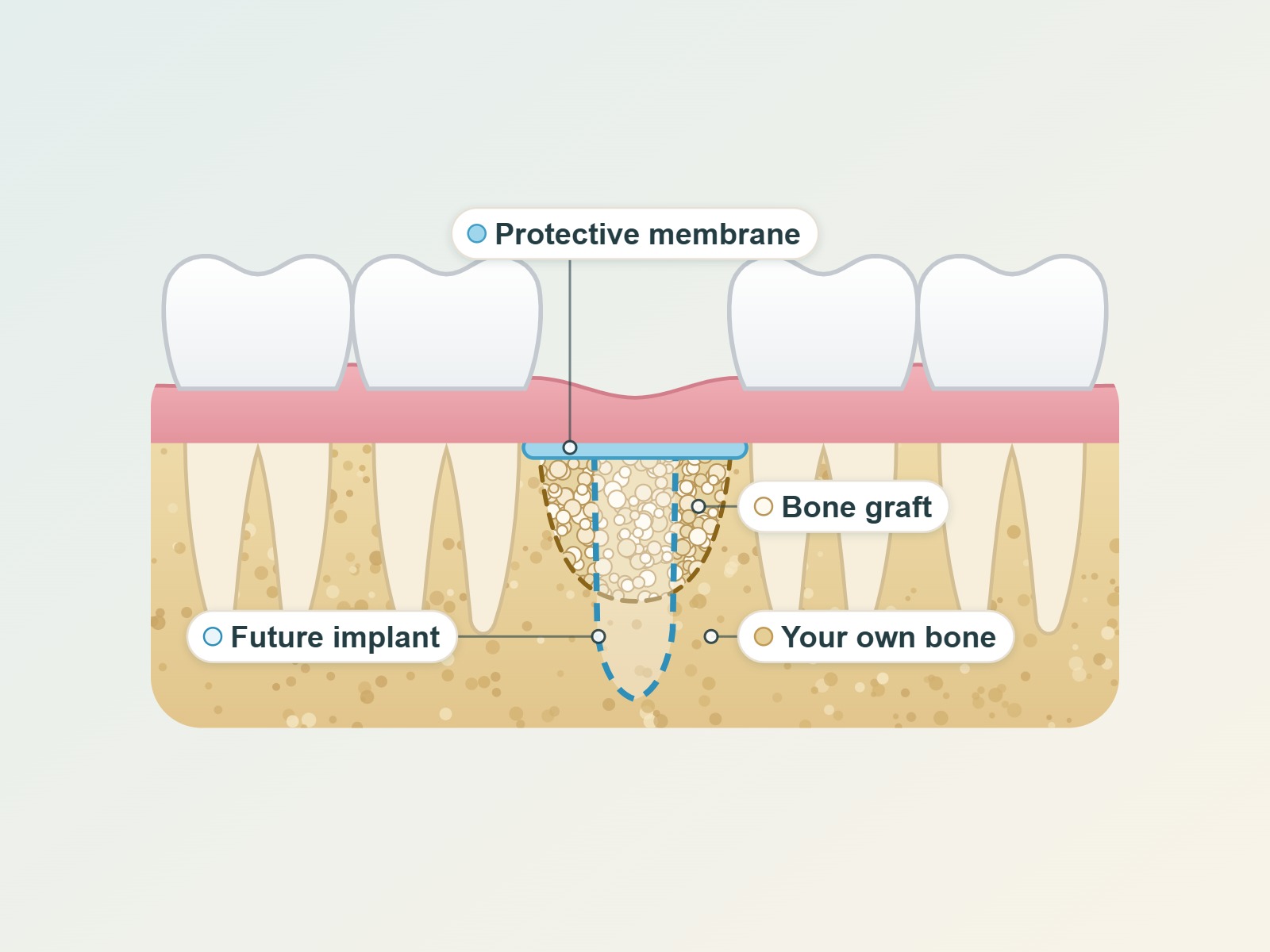
What is a bone graft?
Your jawbone holds your teeth in place. After a tooth is lost, the bone in that area slowly shrinks, and gum disease, infection or injury can reduce it further.
A bone graft adds bone material where bone is missing. Over the following months, your own bone grows into it, with the aim of giving a dental implant enough bone to hold on to.
Not everyone who has an implant needs a graft. We recommend one only when your scan shows too little bone for a stable implant.
Types of bone graft
The graft material can be your own bone, processed donor or animal bone, or a synthetic material. We explain which one we recommend for you and why, and you can tell us if you have a preference.
Do you need a bone graft?
- We examine your mouth, and you have a 3D (CBCT) scan that shows the height and width of your bone.
- We compare your bone with the implant planned for that area; see guided implant surgery.
- We ask about your health, your medicines and smoking, because they affect healing.
- We tell you whether you need a graft, which type, and whether the implant can be placed at the same visit.
How bone grafting works
- Assessment and 3D scanWe check your bone and plan the graft and the implant together.
- Local anaestheticThe area is numbed before the procedure starts.
- Placing the graftThe graft material is placed where bone is missing and, where needed, covered with a protective membrane.
- Closing the gumThe gum is stitched back over the graft.
- HealingNew bone forms over the following months. How long depends on the size of the graft.
- Your implantThe implant is placed once the bone is ready. In suitable cases, it is placed at the same visit as the graft.
Recovery and care
- Swelling, mild bruising or tenderness for a few days is common; we tell you how to manage it.
- Eat soft food and avoid chewing on the area until we tell you it is safe.
- Keep your mouth clean as instructed, and do not press on or disturb the graft.
- Do not smoke: smoking raises the risk of the graft failing.
- Contact us straight away if pain, swelling or bleeding increases.
Travelling for treatment? Read our guide for travelling patients.
Risks and limitations
- As with any surgery, there can be swelling, bleeding or infection.
- A graft does not always take fully, and sometimes a second graft is needed.
- Smoking, poorly controlled diabetes and some medicines can slow healing.
- A graft adds time to your treatment, because the bone needs to heal.
Other options
- Implants without a graft: in some cases, shorter or narrower implants, or the angled implants used in full-arch treatment, can use the bone you already have.
- Other ways to replace teeth, such as a bridge or dentures, which do not need an implant.
Bone grafting: your questions
Does everyone who has a dental implant need a bone graft?
No. Many implants are placed without one. We recommend a graft only when your scan shows too little bone for a stable implant.
Is bone grafting painful?
The area is numbed with local anaesthetic during the procedure. Afterwards, some swelling and tenderness for a few days is common, and we advise you on pain relief.
Can the graft be done when a tooth is removed?
In many cases, yes. Graft material placed in the socket at the time of extraction can help keep the bone for a future implant. If there is infection in the area, it may need to heal first. See socket preservation.
Can the implant be placed at the same time as the graft?
In suitable cases, yes, when there is enough bone to hold the implant steady. Otherwise, the graft heals first and the implant is placed later.
How long does a bone graft take to heal?
Usually several months: often around three to six, and longer for larger grafts. We check the bone before your implant is placed.
Where does the graft material come from?
It can be your own bone, processed donor or animal bone, or a synthetic material. We explain what we recommend for you, and you can tell us if you have a preference.
What is the difference between a bone graft and a sinus lift?
A sinus lift is a type of bone graft for the upper back jaw, where bone is added below the sinus. See sinus lift.
How much does bone grafting cost?
The cost depends on the type and size of the graft. After your assessment, we give you a quote for your full treatment, and you can spread the cost with a payment plan.
Related guides: Dental implant or bridge? · Travelling to Nairobi for implants · Payment plans for implants
Explore the right treatment for your smile.
Our team can discuss your clinical assessment, the proposed stages, recovery, costs and alternative treatment options before you make a decision.