
Guided Implant Surgery in Nairobi
At our Kilimani clinic, we plan your implant on a 3D scan of your jaw and, where it adds value, place it with a custom surgical guide made from that plan, so the implant goes where your new tooth needs it.
What is guided implant surgery?
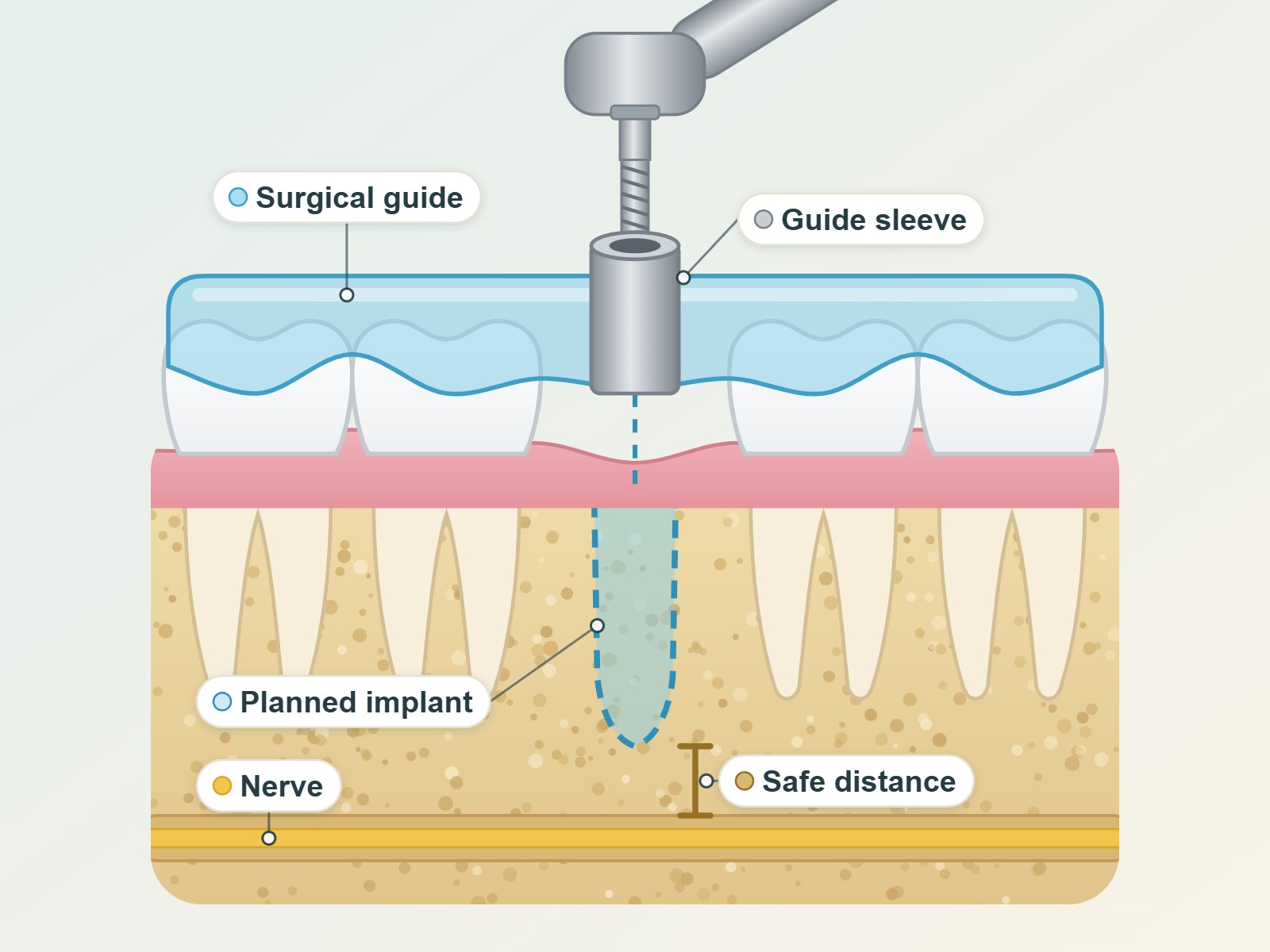
Guided implant surgery means your implant is planned digitally before surgery and then placed with the help of a surgical guide: a small, custom-made template that fits over your teeth or gums and shows where, how deep and at what angle the implant should go.
We plan the implant around the tooth it will carry, your bite and the position of your bone, nerves and sinus. The guide then helps us transfer that plan to your mouth. It is a planning tool that supports your dentist's skill; it does not replace it.
How guided surgery helps you
In suitable cases, the guide also lets us place the implant through a small opening in the gum instead of opening the gum fully.
Your 3D scan and digital plan
- We examine your mouth, and you have a 3D (CBCT) scan that shows the height and width of your bone, your nerves and your sinus.
- Your teeth and bite are recorded with a digital scan or impressions, so the plan includes the space for your new tooth.
- We plan the implant and the future tooth together on the computer and show you the plan.
- If your bone is too thin, we discuss bone grafting or, in the upper back jaw, a sinus lift.
How guided implant surgery works
- Consultation and 3D scanWe examine you, and you have a 3D scan of your jaw.
- Digital planWe plan the implant and your future tooth on the computer and agree the plan with you.
- Your surgical guideA custom guide is made from your plan to fit your mouth.
- Implant placementWith the guide in place, the implant is placed in the planned position, usually under local anaesthetic.
- HealingThe implant bonds with the bone over a few months; in suitable cases, a temporary tooth can be fitted soon after.
- Your new toothYour final crown or bridge is fitted and your bite is checked.
Recovery and care
- Mild swelling or tenderness for a few days is common; we tell you how to manage it.
- Follow the soft diet and cleaning instructions we give you, and do not smoke.
- Come to your review appointments so we can check how you are healing.
- Contact us straight away if pain, swelling or bleeding increases.
Travelling for treatment? Read our guide for travelling patients.
Risks and limitations
- A guide supports accuracy but cannot remove every risk; the usual risks of implant surgery still apply, including infection and an implant that does not bond with the bone.
- A guide needs enough mouth opening and space, so it is not suitable for every case.
- If something unexpected is found during surgery, your dentist may adjust the plan.
Other options
Guided implant surgery: your questions
Is guided implant surgery done by a computer or a robot?
No. The computer is used to plan the implant, and the guide helps your dentist follow that plan. Your dentist performs the surgery.
Is every implant placed with a guide?
No. We recommend a guide when it adds value for your case, for example when space or bone is limited, or for several implants and full arches.
Does the guide make the procedure painless?
No technique can promise that. The implant is usually placed under local anaesthetic, and some swelling or tenderness for a few days afterwards is common.
Why do I need a 3D scan?
A 3D (CBCT) scan shows your bone, nerves and sinus in a way a standard X-ray cannot, so we can plan the implant safely.
Will I receive the permanent crown on the same day?
Not usually: the final crown is fitted after the implant has healed. In suitable cases, a temporary tooth can be fitted first; see immediate implant loading. For full arches, temporary fixed teeth are fitted on the day of surgery or within 72 hours.
How much does guided implant surgery cost?
The cost depends on your treatment plan, for example how many implants you need and whether you need bone grafting. After your assessment, we give you a quote for your treatment, and you can spread the cost with a payment plan.
Related guides: Same-day teeth with implants · Travelling to Nairobi for implants · Payment plans for implants
Explore the right treatment for your smile.
Our team can explain your options, expected stages, aftercare and appropriate alternatives before you make a decision.