
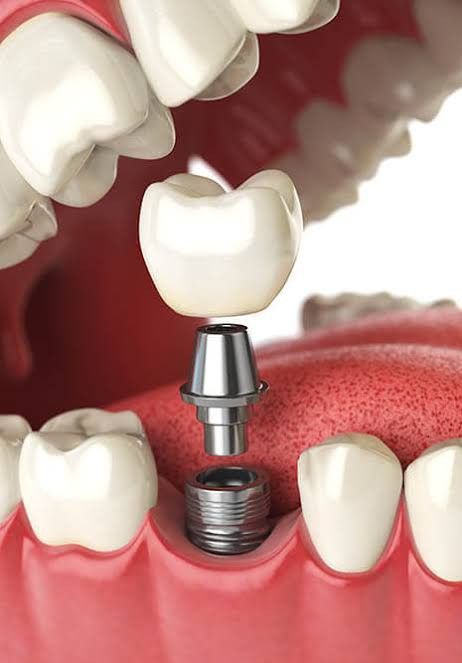
What are dental implants?
A dental implant is a biocompatible fixture, commonly made of titanium or a suitable ceramic material, placed within the jawbone to act as a stable foundation for a replacement tooth or teeth. The implant is not the visible tooth: an abutment or compatible connecting component supports a specially made crown, bridge or larger prosthesis.
Over time, the surrounding bone can bond with the implant surface through a biological healing process known as osseointegration. The planned prosthesis, gum health, available bone, bite, cleaning access and your overall medical history must all be considered before treatment begins.
At IAMC, implant care is planned around the finished smile—not simply the placement of a fixture. One patient may need a straightforward single crown; another may require coordinated bone augmentation, a custom surgical guide or replacement of an entire arch. The sections below explain these pathways separately and in detail.
01 — Single-tooth dental implants
When one tooth is missing, a single implant may support an individual crown without preparing healthy neighbouring teeth to carry a conventional bridge. The implant is positioned in the jaw, and the crown is designed to harmonise with the surrounding teeth in shape, shade, contour and bite.
The visible result is carefully planned from the beginning. In the front of the mouth, the position of the gumline and neighbouring tooth shapes are especially important. In the back of the mouth, chewing forces, access for cleaning and the available distance from adjacent roots influence the restoration.
Timing is individual. The implant may be placed after the extraction socket has healed, or immediately after extraction in carefully selected cases. A temporary tooth may be considered during healing; an immediately placed implant does not automatically mean a permanent crown can be fitted that day.
- Initial assessment Examine the gap, adjacent teeth, gums, bite and relevant medical history; take appropriate radiographs or other records.
- Restorative-led planning Plan the future crown and confirm bone dimensions, gum support and a suitable implant position.
- Placement and healing Place the implant under the agreed anaesthetic plan and monitor stability and tissue healing.
- Custom crown design Use a scan or impression to prepare the abutment and visible replacement tooth.
- Final fit and review Check contacts, appearance and biting forces; explain cleaning and the maintenance schedule.
02 — Multiple dental implants and implant-supported bridges
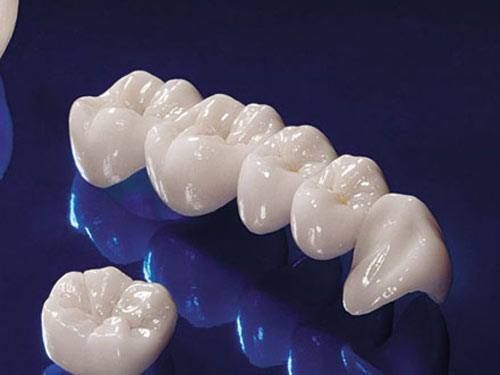
If two or more teeth are missing, treatment can involve several individual implants, separate crowns or a connected implant-supported bridge. A bridge can replace several adjacent teeth while being supported by a carefully selected number of implants; it is not necessary to place one implant for every missing tooth in every case.
The appropriate plan depends on the length of the gap, quality and volume of bone, distribution of chewing forces, condition of neighbouring teeth and the space required for the final restoration. Different arrangements may be considered for isolated gaps, multiple spaces or a long span of missing posterior teeth.
Implant-supported bridges differ from conventional tooth-supported bridges. The former are anchored to implants in bone; the latter use appropriate natural teeth as supporting abutments. Both have useful indications, and your clinician should discuss which is most appropriate for your needs.
03 — Digitally guided implant surgery
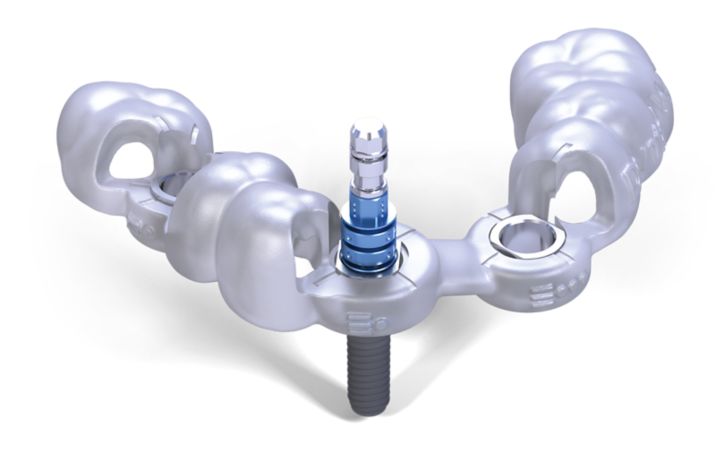
Guided implant surgery uses preoperative digital planning and a custom surgical template to help transfer a proposed implant position from the computer to the patient’s mouth. The goal is to coordinate implant placement with the intended crown or bridge while accounting for jawbone, nerves, sinuses and neighbouring roots.
Where clinically indicated, a cone-beam CT (CBCT) scan may be combined with an intraoral scan or other surface record. Planning software helps the clinician assess potential implant positions, depth, angulation and prosthetic space. A tooth-, tissue- or bone-supported surgical guide can then be produced for the selected technique.
A guide is an aid to clinical precision, not a fully automated operation. Fit, stability, mouth opening, imaging accuracy and the actual surgical findings must be checked. Some cases are better managed using conventional or partially guided placement, and the surgical team must be prepared to change the approach if necessary.
- Clinical and digital assessment Review the health of the mouth and determine whether three-dimensional planning adds value.
- Virtual implant positioning Consider nerve and sinus anatomy, bone volume, tooth position and the future restoration.
- Guide fabrication Create the patient-specific guide and check its planned support and fit.
- Guided surgical placement Use the guide during indicated drilling or placement steps while confirming clinical conditions.
- Restoration and follow-up Monitor healing before completing the crown, bridge or other implant-supported prosthesis.
04 — All-on-X and full-arch implant rehabilitation
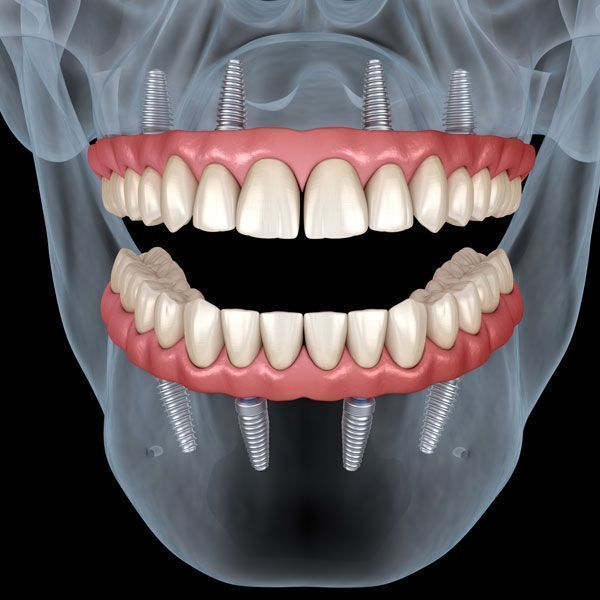
All-on-X is a treatment concept for replacing most or all teeth in one jaw using a full-arch prosthesis supported by a planned number of implants. The “X” reflects the chosen configuration, which depends on the patient’s anatomy, available bone, bite and restorative design. All-on-4 and All-on-6 are examples, not a rule that applies to everyone.
A comprehensive full-arch plan begins with the existing teeth and gums: which teeth can be preserved, which may need extraction, whether the jawbone can support implants and what kind of final smile will be comfortable, cleansable and functional. The clinician also evaluates facial support, speech, lip position, bite and how the upper and lower arches meet.
The final restoration may be a fixed full-arch bridge secured to implants, generally removed by a clinician when necessary. In some cases an implant-retained removable overdenture is more suitable; this can be taken out by the patient for cleaning. These alternatives have different maintenance requirements and should be explained during planning.
Some suitable patients can receive a temporary fixed prosthesis shortly after implant placement. Others need a staged approach with healing and a provisional removable solution. Early temporary teeth and the final long-term prosthesis are separate treatment stages; same-day permanent teeth cannot be presumed.
- Comprehensive full-mouth review Assess remaining teeth, infection or gum disease, bone, bite, appearance and patient goals.
- Prosthesis-first design Plan tooth position, speech, lip support, cleaning access and implant distribution.
- Preparation and surgery Complete necessary extractions or augmentation and place implants where suitable.
- Provisional replacement teeth Provide a temporary fixed or removable prosthesis according to implant stability and the treatment plan.
- Final rehabilitation Fabricate, try in and fit the definitive arch after appropriate healing and assessment.
- Maintenance programme Review the prosthesis, soft tissues, hygiene access, attachments, screws and bite regularly.
05 — Bone grafting for dental implants
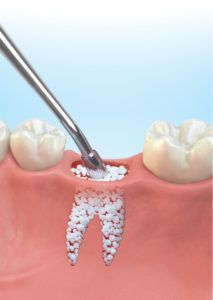
Implants need suitable support from the jawbone. After tooth extraction, long-standing tooth loss, periodontal disease, infection or trauma, the bone ridge may become narrower or lower than is ideal for the planned implant. Bone grafting is an augmentation procedure intended to support reconstruction of the site where clinically indicated.
Graft material may be taken from the patient or sourced from a carefully processed human, animal-derived or synthetic material. The choice takes account of the size and location of the defect, healing objectives, medical history and patient preferences. Protective membranes are sometimes used to help guide healing.
Not every patient requires grafting. A graft can sometimes be completed during tooth extraction or implant placement; more extensive reconstruction may need to heal before the implant is placed. Healing and bone remodelling may take several months and are reassessed before the next stage.
- Imaging and assessment Examine the ridge and measure available bone using appropriate investigations.
- Choose grafting approach Discuss material, likely sequence, site preparation and whether a membrane is needed.
- Site preparation and augmentation Place the selected material and protect or close the surgical site as planned.
- Healing and reassessment Review the tissues and available bone before proceeding with implant placement or restoration.
06 — Sinus lifting and upper-jaw implant preparation
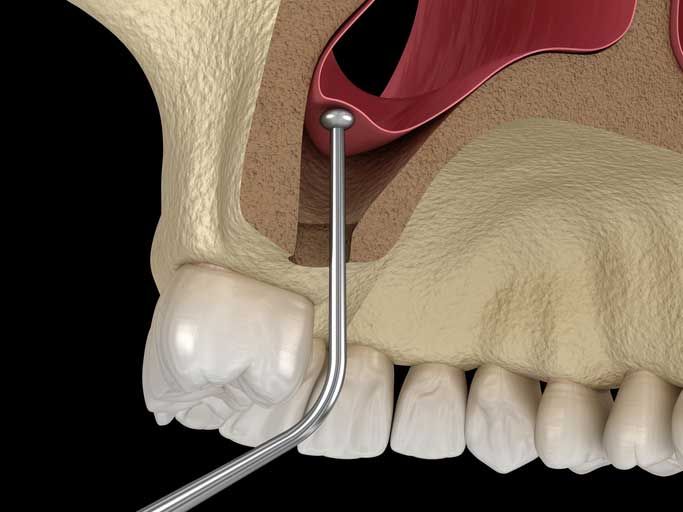
The maxillary sinuses are air-filled spaces above the upper back teeth. After the loss of upper molars or premolars, the available bone height beneath a sinus may be insufficient for a particular planned implant. A sinus lift—also called sinus floor elevation or sinus augmentation—can develop additional space for bone support in carefully selected patients.
During the procedure, the sinus lining is gently lifted to create room beneath it. Graft material may be placed in the space, depending on the technique and plan. This is different from bone grafting for a narrow ridge: it addresses a specific anatomical problem beneath the floor of the upper-jaw sinus.
The technique is chosen after clinical examination and appropriate imaging, often including CBCT when clinically indicated. The clinician evaluates existing bone height, the shape and health of the sinus, membrane condition, nearby structures and any history of nasal or sinus problems.
An implant may sometimes be placed during the same appointment if there is enough original bone to provide initial stability. Otherwise a staged approach allows the graft to heal first. Sinus lifting is not necessary for every upper back-tooth implant.
- Detailed assessment Examine upper-jaw bone height, sinus anatomy, symptoms and restorative objectives.
- Anaesthesia and access Numb the area and access the sinus floor by the planned technique.
- Membrane elevation Carefully raise the sinus membrane, preserving it where possible.
- Bone augmentation Place graft material when indicated and decide whether simultaneous implant placement is suitable.
- Healing and follow-up Provide sinus-specific precautions, review healing and schedule the next restorative stage.
07 — Implant crowns, bridges and final restorations
Implant placement is only one part of treatment. The final restoration is the visible tooth or set of teeth that allows you to smile, speak and chew. The implant fixture supports the prosthesis through an abutment or compatible connection, and each part must be selected with fit, bite and daily cleaning in mind.
For a single tooth, a carefully matched crown restores shape and chewing contacts. Several implants may support individual crowns or a larger bridge. Full-arch restorations require additional planning for lip support, speech, the design of the gum-coloured portion if used and the ability to clean around and under the prosthesis.
Common options include selected ceramics, zirconia-based restorations and metal-ceramic designs where suitable. Connections may be screw-retained or cement-retained; their selection depends on the implant system, site and prosthetic design. Digital scanning and laboratory fabrication can support the final result.
Your consultation, assessment and implant plan
Before recommending a procedure, IAMC assesses the mouth as a whole. A successful plan considers the quality of the remaining teeth, the condition of the gums, untreated infection, bite relationships, jawbone volume and access for daily cleaning. Your dental and medical history—including medicines and conditions that may affect healing—also matters.
The team may use photographs, intraoral scans or impressions, routine dental radiographs and three-dimensional imaging when justified by the case. Digital records help show how your intended crown, bridge or arch relates to the bone and surrounding anatomy.
You should leave your consultation understanding the proposed treatment pathway, any preparatory care, likely visits, healing stages, provisional teeth, the materials being considered and how the final restoration will be maintained.
- Assessment of missing teeth, neighbouring teeth, gums, oral hygiene and existing prostheses.
- Appropriate imaging for bone height and width, adjacent roots, nerves, sinus position and site anatomy.
- Planning of final tooth shape, shade, bite, available space and the best implant distribution.
- Discussion of guided versus conventional placement, grafting, sinus lifting or staged options where relevant.
- A personalised sequence of surgery, healing, temporary teeth, final restoration and reviews.
Your dental implant journey — from consultation to final smile
Implant treatment is a coordinated process, and the number of visits differs by clinical need. The outline below brings together the phases that may feature in a straightforward case or a more complex full-arch rehabilitation.
- Consultation and diagnosis Discuss goals; examine oral health, medical history, bite and missing-tooth sites.
- Digital assessment and design Capture suitable scans and imaging, plan the future teeth and position implants accordingly.
- Preparatory treatment where needed Treat gum disease or infection, consider extraction, bone grafting or sinus augmentation if appropriate.
- Implant placement Position the implant or implants using an agreed surgical approach and anaesthesia plan.
- Healing and temporary restoration Allow tissues to heal and assess stability. Provide a provisional solution when suitable.
- Final restorative phase Record the healed situation, design and fit crowns, bridges or a full-arch prosthesis.
- Personalised maintenance Review biting forces, implant tissues and prosthesis components; reinforce effective cleaning.
Why patients consider dental implants
Implant-supported replacement teeth may be considered when people want a stable, carefully planned option for restoring missing teeth. Treatment aims to support comfortable function and natural-looking results, while the final design is tailored to the patient’s needs rather than one standard package.
- In some single-tooth cases, implants avoid the need to prepare adjacent healthy teeth for a conventional bridge.
- Implants can help support fixed replacement teeth or improve retention of selected removable prostheses.
- An implant-supported approach can be incorporated into a broader rehabilitation plan for chewing, speaking and appearance.
- Carefully designed restorations make daily hygiene, professional review and component maintenance part of the plan.
Why choose IAMC for dental implant treatment?
Dental implants require more than placing a fixture in bone. At IAMC, we combine clinical experience, digital planning and carefully made restorations to deliver treatment that is personalised, comprehensive and focused on long-term success.
Highly experienced implantologist
Your care is guided by an experienced implantologist who evaluates the surgical site, bite, gum aesthetics and long-term function before treatment begins.
Digital workflow and guided planning
We use digital records, restorative-led planning and guided workflows where appropriate to improve precision, visualisation and communication throughout treatment.
High-quality implant work
From implant positioning to the final crown, bridge or full-arch prosthesis, we focus on high-quality workmanship, fit, aesthetics and durability.
Comprehensive solutions in one place
Single implants, multiple implants, full-arch rehabilitation, bone grafting, sinus lifting and final restorations can all be coordinated within one implant treatment pathway.
Personalised smile and function planning
Every implant case is tailored around the finished smile, chewing comfort, speech, gum support and daily cleaning needs—not a one-size-fits-all package.
Support before, during and after treatment
We prioritise clear explanations, realistic treatment sequencing, attentive reviews and long-term maintenance so patients feel supported at every stage.
Healing, home care and long-term implant maintenance
After implant placement or grafting, follow the written instructions from your treating clinician. Temporary tenderness, swelling or bruising can occur after surgery. The suggested diet, mouth care, medication and review timetable depend on the actual treatment performed.
Implants and prosthetic teeth still require daily cleaning. Plaque around an implant can affect the surrounding gums and supporting tissues. Cleaning needs vary by restoration: an implant crown is different from a connected bridge, and a fixed full arch may need special aids to access its underside.
Regular professional reviews assess the gums, bone support where indicated, bite, screw-retained components, restorations and access for home care. Contact your clinician for increasing pain, unexpected swelling, fever, bleeding that does not settle, looseness or difficulty cleaning.
- Brush carefully around the implant restoration and follow the specific interproximal or bridge-cleaning guidance provided.
- Keep all review appointments, especially during healing or after a complex full-arch restoration.
- Protect supporting gum health and address any persistent inflammation or discomfort early.
- If you grind or clench your teeth, ask whether additional bite monitoring or protection is appropriate.
- After grafting or sinus surgery, follow the extra site-specific precautions given by your surgeon.
How dental implants compare with other tooth-replacement choices
The most appropriate choice depends on existing teeth, bone, oral health, daily-care preferences, restorative goals and the examination findings.
| Treatment pathway | Common use | Key design feature |
|---|---|---|
| Single implant crown | One missing tooth | An implant fixture supports one custom visible crown. |
| Multiple implants / implant bridge | Several missing adjacent teeth | Individual crowns or a connected bridge are supported by a planned implant arrangement. |
| All-on-X full arch | Most or all teeth missing in one jaw | A full-arch prosthesis is supported by multiple implants selected for the case. |
| Conventional fixed bridge | A gap with suitable natural tooth supports | A bridge is supported by prepared natural teeth rather than implants. |
| Removable denture | Partial or complete tooth loss | Replacement teeth can be taken out for daily cleaning; implants may improve retention in selected cases. |
Frequently asked questions
How many teeth can dental implants replace?
One implant can support a crown, several implants can support a group of teeth, and a planned implant distribution may support a full-arch prosthesis. The number of implants depends on your anatomy and restorative plan.
Do I need one implant for every missing tooth?
No. Implant-supported bridges may replace multiple adjacent teeth with fewer fixtures than missing teeth, depending on the span, bone, bite and design.
Is guided implant surgery the same as robotic surgery?
No. A clinician performs the procedure. Digital planning and a guide can assist with implant positioning in appropriate cases.
What is the difference between All-on-4 and All-on-X?
All-on-4 refers to one possible four-implant arrangement; All-on-X means that the number of supporting implants is selected according to the clinical plan.
Will I have fixed teeth on the day of implant surgery?
Not necessarily. Some cases permit early provisional teeth. Others require healing before a temporary or final restoration can be fitted.
Can bone grafting and implants be done together?
Sometimes. Grafting can be simultaneous with placement when the site permits implant stability, or it can be staged before implant surgery.
Does every upper molar implant require a sinus lift?
No. Bone height, sinus anatomy and the proposed implant determine whether sinus augmentation is indicated.
What is the difference between bone grafting and sinus lifting?
General bone grafting develops deficient jawbone in a variety of sites. A sinus lift specifically elevates the sinus lining to create room for support beneath the upper posterior sinus.
Does every dental implant need a crown?
Not every implant supports a single crown. Implants may support bridges, full-arch fixed teeth or removable implant-retained prostheses.
Can a complete set of teeth be supported by implants?
In suitable cases, a fixed or removable full-arch prosthesis may be supported by implants after a detailed examination and restorative plan.
How long does the entire treatment take?
The sequence depends on extractions, grafting, implant stability, healing and prosthesis fabrication. Your clinician will explain your proposed stages rather than using one standard timeline.
Do implant teeth need cleaning and professional reviews?
Yes. Daily cleaning and regular professional maintenance are essential for healthy implant tissues and the long-term care of prosthetic components.