
Guided Bone Regeneration (GBR)
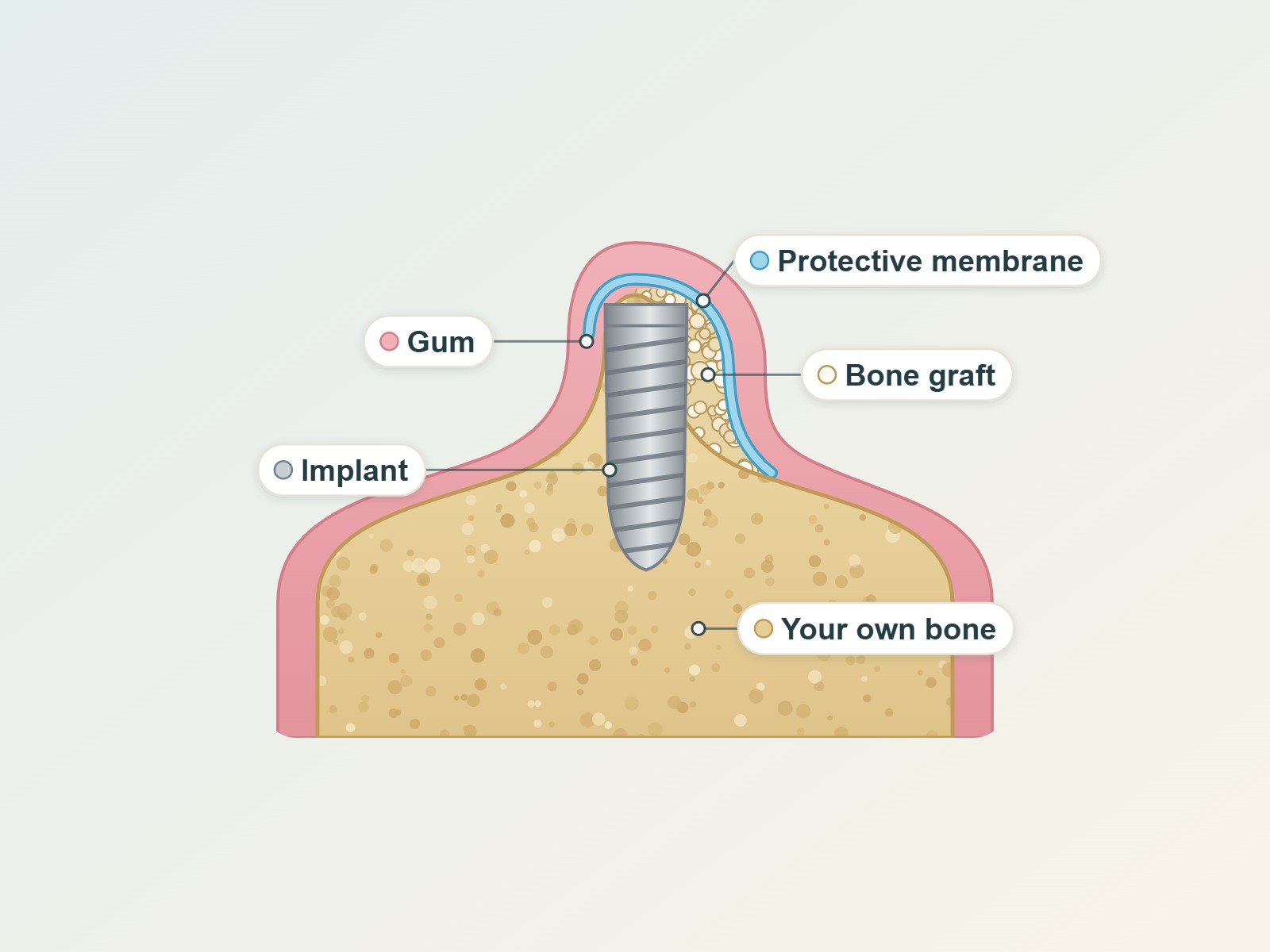
Guided bone regeneration (GBR) covers a bone graft with a thin protective membrane, so that new bone has the space and time to form. At our Kilimani clinic in Nairobi, we use it to rebuild bone around or before a dental implant.
What is guided bone regeneration?
Gum tissue grows faster than bone. If a bone graft is left uncovered, gum can grow into the space before new bone has formed.
In guided bone regeneration, the graft is covered with a thin membrane. The membrane keeps the gum out and holds the graft in place, which gives your own bone time to grow into it.
GBR is a technique used in many types of bone grafting, including ridge augmentation.
When GBR is used
Is it right for you?
- We examine your mouth, and you have a 3D (CBCT) scan that shows where bone is missing and how much.
- We plan the implant first, then plan the graft around it.
- We check your gums. Healthy gum is needed to cover the membrane, so gum disease is treated first.
- We ask about your health, your medicines and smoking, because they affect healing.
How guided bone regeneration works
- Assessment and 3D scanWe check your bone and plan the graft and the implant together.
- Local anaestheticThe area is numbed before the procedure starts.
- Opening the gumThe gum is gently lifted to show the bone.
- Placing the graftBone graft material is placed where bone is missing.
- Placing the membraneThe membrane is laid over the graft and, where needed, fixed in place.
- Closing and healingThe gum is stitched over the membrane, and new bone forms over several months.
Recovery and care
- Swelling and some bruising for a few days is common; we tell you how to manage it.
- Do not press on the area, and do not wear a denture over it until we tell you it is safe.
- Eat soft food and chew on the other side.
- Keep your mouth clean as instructed.
- Do not smoke: smoking raises the risk of the graft failing.
- Contact us straight away if you can see or feel the membrane, if the stitches open, or if pain, swelling or bleeding increases.
Risks and limitations
- As with any surgery, there can be swelling, bleeding or infection.
- The membrane can become exposed if the gum opens while it heals. This needs a prompt review and can reduce the amount of new bone.
- The graft may give less bone than planned, and a second graft is sometimes needed.
- A membrane that does not dissolve needs a small second procedure to remove it.
Other options
- A graft without a membrane, for some small areas.
- Narrower, shorter or angled implants, which can sometimes avoid a graft; see dental implants.
- Other ways to replace teeth, such as a bridge or dentures, which do not need an implant.
Guided bone regeneration: your questions
Is GBR the same as a bone graft?
GBR is one way of doing a bone graft: the graft material is covered with a membrane that protects it while new bone forms.
What is the membrane made of?
Many membranes are made of collagen from an animal source and dissolve on their own. Some firmer membranes, used for larger grafts, are removed later in a small procedure. Tell us if you have a preference, and we will discuss the options with you.
Can GBR be done at the same time as the implant?
In suitable cases, yes, when the implant is held firmly by your own bone and only a small area needs covering. Otherwise, the graft heals first.
How long does it take to heal?
Usually several months: often around four to six, and longer for larger grafts. We check the bone before the next stage of your treatment.
Will I feel the membrane?
No. It lies under the gum. If you ever see or feel it, contact us so that we can check the area.
How much does guided bone regeneration cost?
The cost depends on the size of the graft and the materials used. After your assessment, we give you a quote for your full treatment, and you can spread the cost with a payment plan.
Related treatments: Bone grafting · Ridge augmentation · Socket preservation
Explore the right treatment for your smile.
Our team can discuss your clinical assessment, the proposed stages, recovery, costs and alternative treatment options before you make a decision.